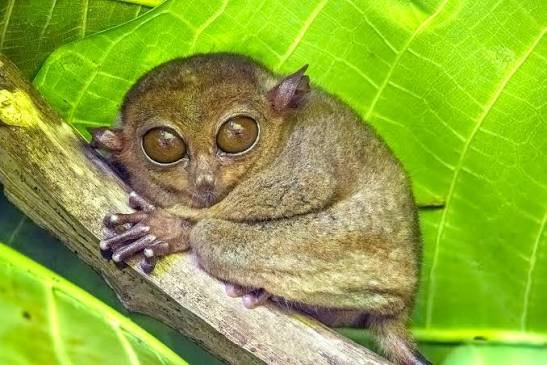
In the forests of Bohol, a tiny nocturnal primate quietly watches the darkness. But behind those enormous eyes is a species whose survival depends on how carefully people treat the forest it calls home.
At first, you might think it is watching you.
Two enormous eyes stare from the darkness. A tiny body clings tightly to a branch, almost perfectly still. Its ears twitch. Its head turns slightly. Then, in a flash, it disappears into the vegetation.
This is the Philippine tarsier, locally known as the “maomag”, one of the country’s smallest and most recognizable mammals.
It may fit comfortably in the palm of a hand, but its importance stretches far beyond its size.
In the forests of Bohol, particularly around Corella, Sikatuna and Loboc, the tarsier has become more than a symbol of wildlife. It represents the delicate relationship between animals, forests, communities and tourism.
And sometimes, protecting something small requires seeing the bigger picture.
Unlike animals that are active during the day, the tarsier comes alive after sunset. While the forest is quiet during daylight hours, it rests by clinging to branches and vegetation.
When night falls, it becomes a hunter.
Its large eyes help it see in low-light conditions, while its powerful hind legs allow it to leap between branches. Its hands and feet provide a strong grip as it moves through the vegetation.
And despite its innocent appearance, the tarsier is a predator.
It feeds mainly on insects and other small animals, searching through the forest at night for its next meal.
The giant eyes that make the tarsier so fascinating to tourists are not simply there to make it look unusual. They are part of the animal’s adaptation to a world dominated by darkness.
The tarsier’s size is one of the reasons it captures attention.
But its value cannot be measured by its appearance.
As an endemic species, the Philippine tarsier is naturally found only in the Philippines. Losing it would therefore mean losing a piece of the country’s unique natural heritage.
In Bohol, that connection is particularly visible.The Philippine Tarsier Sanctuary in Corella provides visitors with an opportunity to observe the animals in a protected environment. Conservation efforts involving organizations, government agencies, local communities and guides aim to protect both the tarsiers and the habitats they depend on.
For visitors, the experience can be memorable.
But for the tarsier, a visitor is still a disturbance if proper care is not taken.
There is a reason visitors are told to lower their voices.
There is a reason touching is prohibited.
There is a reason camera flashes are discouraged.
The tarsier is a wild animal, not a stuffed toy brought to life for photographs.
Its small size and unusual appearance can make it tempting to approach. But responsible wildlife tourism requires the opposite: observe without interfering.
Visitors to tarsier conservation areas are encouraged to remain quiet, avoid touching the animals, keep their distance and follow the instructions of guides.
The goal is not simply to give tourists a closer look.
It is to allow people to see the animal without making the animal pay the price for being seen.
A tarsier cannot survive simply because a sanctuary has a sign bearing its name. It needs a suitable habitat.
Trees and vegetation provide the branches where it rests, moves and hunts. The forest provides insects and other prey. The surrounding ecosystem creates the conditions that allow the species to continue living.
This is why tarsier conservation is ultimately also habitat conservation.
For years, the species has faced threats including habitat loss, hunting, illegal capture, wildlife trade and improper captivity.
Keeping a tarsier as a pet may seem harmless because of its small size. But a forest animal has needs that a household cannot simply reproduce.
A tarsier belongs in an environment where it can behave like a tarsier—not where it is treated like a domesticated animal.
The tarsier’s unusual appearance has helped make it famous. But that fame comes with a risk.
When wildlife becomes a tourist attraction, there is always a line between appreciation and exploitation.
Tourism can help create awareness, provide employment and support conservation activities. Visitors can leave Bohol knowing more about the species and why its habitat matters.
But unmanaged tourism can also bring noise, disturbance and pressure on wildlife sites.
The challenge, therefore, is not simply to bring more people to see the tarsier.
It is to make sure that people can see it without harming what they came to admire.
The story of the Philippine tarsier extends beyond Bohol’s tourism industry.
It is part of the country’s biodiversity and natural heritage. Bohol’s recognition as the Philippines’ first UNESCO Global Geopark in 2023 further places the tarsier within a broader story of the island’s geological, biological and cultural treasures.
The tarsier is one small piece of that landscape. But sometimes, a small piece can tell the story of an entire ecosystem.
When a forest disappears, the tarsier loses more than a place to sleep. It loses hunting grounds, shelter and the environment that has allowed its species to survive.
That is why conservation cannot stop at protecting the animal people see.
It must also protect the forest people may never notice.
The Philippine tarsier has survived by adapting to the darkness. But its future depends on what happens in the light.
Every quiet observation, every protected forest and every decision not to capture or disturb wildlife contributes to a larger effort to keep the species in its natural home.
The tarsier does not need to be touched to be appreciated.
It does not need a flash photograph to prove that it was there.
Sometimes, the most responsible way to experience wildlife is simply to stand quietly, look into those enormous eyes and then let the animal return to the forest.
Because the Philippine tarsier may be tiny, but its disappearance would leave a much larger silence.
Those giant eyes have watched the Philippine forests for generations. The question now is whether we will protect the forests long enough for them to keep watching.
Leave a Reply